Automated E-commerce Storytelling That Converts
The truth behind every successful e-commerce marketing campaign is that product specs don’t sell—stories do.
Think of the customer in search of the perfect running shoe. They're not looking for EVA midsoles and mesh uppers; they’re looking for a faster 5K. Then there's the busy parent shopping for a blender to make quick meals. They're not in search of 1200 watts of power; they want quieter mornings.
Telling those stories across thousands of SKUs, seasons, channels, and segments? That’s where most e-commerce marketing teams stall.
That storytelling takes time and skill. So you can't handcraft a novel for every product page, or keep copy fresh with every new collection launch. It's overwhelming to A/B test five angles for each SKU while also feeding search, social, and email.
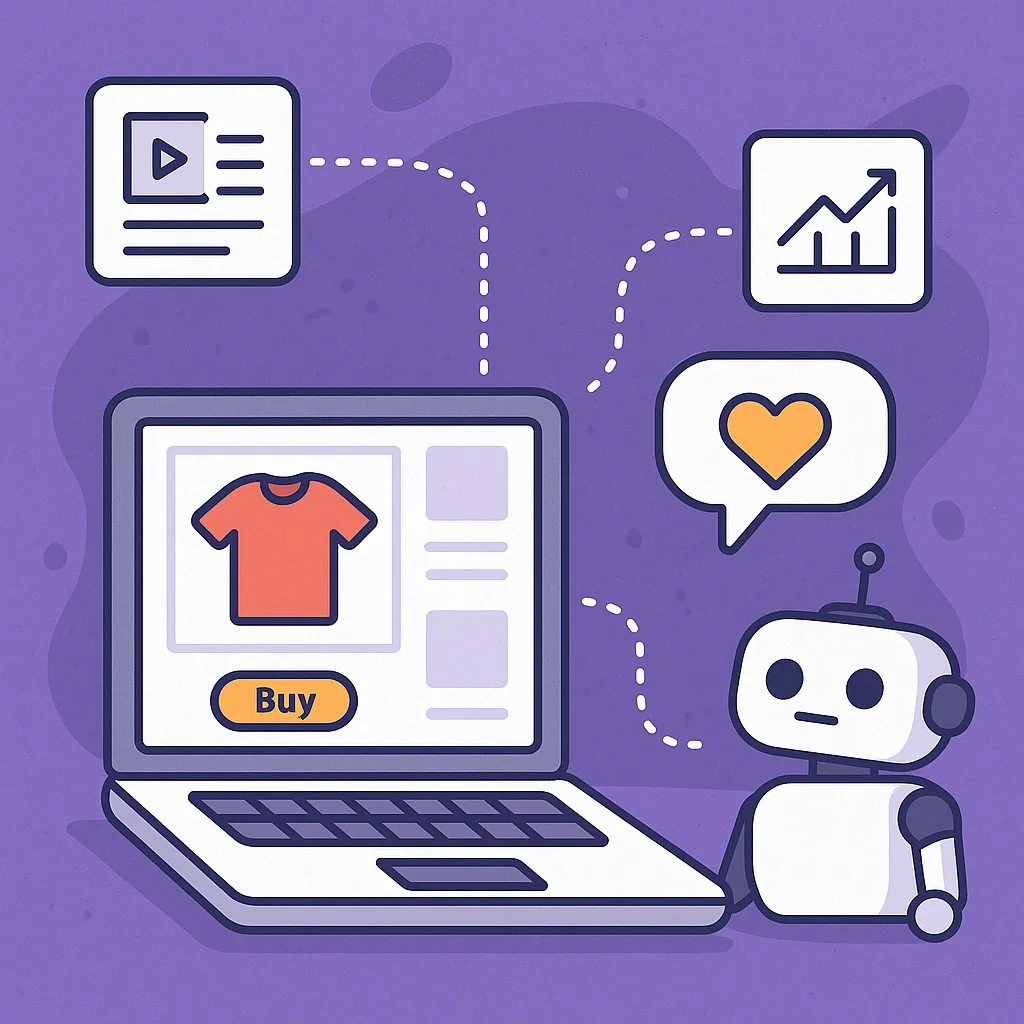
There’s a better path: content that converts itself. Not because it’s generic or purely machine-made, but because it is intelligently generated, human-refined, and continuously improved without micromanagement. It's like hiring a strategist who never sleeps and a merchandiser who never runs out of words.
Why Manual Product Storytelling Doesn’t Scale
So, marketers know the importance of storytelling. But why doesn't it scale? What's putting pressure on your content team that's preventing them from constantly refreshing those dynamic and essential stories as your e-commerce business grows?
Let's break it down:
-
The long-tail gap: Your top 20% of products get attention; the other 80% live with placeholder copy that underperforms in both SEO and conversion.
-
Launch pressure: Every drop, variant, and bundle arrives with the same urgent need for on-brand copy. Your calendar is already full and your team doesn't have time to execute on every content need.
-
Inconsistent voice: Multiple contributors across teams and regions lead to fractured brand tone.
-
Fragmented data: Reviews, returns, search queries, competitor claims, and internal analytics are scattered across tools, rarely informing your copy in a systematic way.
-
Compliance risk: In regulated categories, speed collides with accuracy and legal review.
-
Execution drag: Content strategy decks gather dust because you don’t have the bandwidth to turn them into published, measurable output that performs.
The bottlenecks and roadblocks are huge, but with the right combination of human talent and advanced technology, easy to overcome.
Meet Content That Converts Itself
Here's the solution: orchestrating AI intelligence with human creativity. As a result, your product stories are:
- Strategically generated using your catalog, customer behavior, and market signals
- Written at the right fidelity for each SKU—sometimes fully human, sometimes AI, often hybrid
- Automatically ordered, edited, and published through your CMS
- Measured against engagement and conversion—and then switched up as the system learns what works best
Think of it as turning your existing content catalog into a newsroom. Your most successful content gets feature coverage. Your long-tail searches get beat reporting. Every piece is part of a cohesive editorial plan that your team doesn’t have to chase down.
What a “Self-Converting” Product Story Actually Looks Like
A high-performing product page is more than a paragraph of fluff and a bullet list of specs. Our "self-converting" system knows this, and assembles a persuasive narrative that fits your brand and category. Here's what happens to create an impactful story:
-
A hook aligned to shopper intent: Lead with the outcome shoppers care about (“Shave minutes off your morning routine”).
-
Benefits before features: Translate attributes into lived experiences (“Double-walled insulation keeps drinks cold through your longest trail days”).
-
Social proof: Pull signals from reviews and user-generated content (UGC) to validate claims.
-
Objection handling: Address and debunk common purchase hesitations in plain language.
-
SEO-friendly structure: Headings, FAQs, and semantic keywords that don’t read like keywords.
-
Clean microcopy: Write tighter feature bullets, comparison highlights, and alt text that supports accessibility and search.
-
Trust and compliance: Include correct terminology, appropriate disclaimers, and sourcing when needed.
-
Cross-sell prompts: Punctuate with tasteful, context-aware suggestions based on compatibility and behavior data.
It's everything a story needs to sell your product to your target market.
How It Works Behind the Scenes
The results sound good, but how does the execution of "self-converting" content happen? Let's break it down into the six most critical steps:
1) Strategic Agents learn your world
Intelligent AI modules get an in-depth primer on your brand and content.
-
Ingest your site corpus, product feed, style guides, brand voice, and historical performance.
-
Analyze competitors, category language, and search trends to understand where you can stand out.
-
Map seasonality and promotional cadence so product stories sync with your merchandising calendar.
2) The Content Weighting Engine decides the right level of human vs AI
Each piece of content needs the right mix of technology and the creative eye of a person, always striking a balance depending on intent.
-
High-impact or complex SKUs: Flagged for human-crafted or hybrid treatment (AI draft plus expert editor).
-
Long-tail and repeatable templates: Generated by AI, then verified by an editor for accuracy and tone.
-
Regulated or highly nuanced categories: Hybrid by default, with compliance guardrails.
This is how you get speed without sacrificing voice or risk management. It's the right writer for every job—sometimes human, sometimes AI, always intelligent.
3) Drafting frameworks turn attributes into narratives
The system takes specific action to develop the right narrative for each piece.
-
Use proven storytelling patterns. Think problem-solution, before-after-bridge, benefit-feature-proof. These build first drafts that already sound like your brand.
-
Pulls in customer language from reviews and support logs to reflect how people actually talk about your products.
-
Structures content for scanners and searchers. Think scannable bullets, rich FAQs, and internal links to buying guides and comparison pages.
It's like having an expert content developer on-call to craft the right story for your brand.
4) Human editors make it unmistakably yours
Real people give your content the essential finishing touch, after smart AI has done a first draft. Expert editors:
-
Refine tone, add sensory detail, and ensure empathy and nuance.
-
Fact-check claims, enforce legal and compliance requirements, including accessibility standards.
-
Align copy with visuals and merchandising strategy, suggesting alt images, hero headlines, and appropriate cross-sell anchors.
AI efficiency with human perfection. Every AI-assisted piece is human-verified.
5) Autonomous execution publishes and updates
Our "self-converting" system also adds each piece to your content ecosystem.
- Approved content is pushed to your CMS and mirrored across category pages, landing pages, and relevant buying guides.
- The system schedules refreshes around drops, seasonality, and new reviews so stories don’t go stale.
- You can choose to auto-publish for low-risk SKUs or require approval for high-visibility products.
6) Continuous learning improves conversion over time
One critical benefit is the capacity to learn from your content's performance. That way, strategic direction is automatically updated on a regular basis, so you can take advantage of new opportunities. The system:
- Ingests engagement and conversion data—scroll depth, add-to-cart rate, PDP bounce, organic ranking and CTR, even return reasons.
- Identifies which angles win (e.g., durability vs. lightness for hiking packs) and adjusts future drafts.
- Reallocates human attention where it matters most, updating the weighting mix of content types.
Where Self-Converting Stories Show Up Across Your Store
Content is a critical marketing tool across your online properties. So let's review where these self-converting stories make the most impact.
-
Product detail pages: The core narrative, structured FAQs, benefits bullets, and trust copy.
-
Category and collection pages: Seasonal stories, comparison highlights, and curated themes that move visitors deeper.
-
Search and browse pages: Concise, benefit-led snippets that increase click-through.
-
Lifecycle campaigns: Product snippets for emails and SMS that reflect the same narrative and proof points.
-
Support and knowledge: Care guides and how-tos that reduce returns and build confidence.
-
Blog and buying guides: Evergreen content that links back to products and strengthens topical authority.
The result is a consistent, ever-improving story that follows the shopper from discovery to decision—without your team scrambling to keep up.
Transparency You Can Trust
With self-converting content, you always remain in control. We know that trust is earned when you can see how decisions get made. So, you’ll always know:
- What was written by AI, what was refined by humans, and why the system chose that mix
- Which inputs trained the draft (product attributes, reviews, search trends, competitor differentials)
- What changed after performance data came in—and how that data will influence the next iteration
Your new content engine is not a black box. It’s a transparent, glass box that shows its work.
What Changes For Your Team
With this intelligent automation, it might sound like your team won't have much to do. In fact, you're positioned to better use their skill sets to grow your business. Here's what changes with self-converting content:
-
From writing to directing: Your marketers focus on brand story, positioning, and merchandising ideas; the system handles the volume and velocity.
-
From one-off tasks to continuous improvement: You’re not rewriting pages from scratch; you’re setting guardrails and letting performance guide updates.
-
From bottlenecks to bandwidth: Your writers and editors spend their time on the products and moments that matter most.
-
From risk to reassurance: With human verification and compliance workflows, you publish faster without jeopardizing trust.
Three Quick Snapshots
Let's have a look at how this works in practice with a few case studies.
DTC footwear brand with seasonal drops
AI drafts lifestyle-first product detail pages (PDP) using athlete reviews and trail community language. Human editors sharpen tone and localize for geographic-specific sites like the UK and Australia. Long-tail keyword variants finally get quality copy that ranks, so your pages show up on those all-important niche Google searches.
Home goods marketplace with 15,000 SKUs
Those SKUs get copy that's right for their needs, whether it's AI, human, or hybrid.
Top 10% revenue drivers receive hybrid treatment; the middle 40% get AI-generated copy with human quality assurance (QA); the remaining SKUs get verified AI descriptions with FAQ blocks. This gives search engines all they need to find and rank this content. Organic traffic grows on your category pages, because the entire content catalog becomes more semantically rich.
Supplements company with strict claims policies
Content for this type of brand is hybrid by default. AI assembles a content draft with evidence-backed claims and disclaimers. Human editors and legal advisors approve the content.
Buying guides link to products, so purchase is quick and easy. Copy incorporates transparent language that improves time on page and makes sure customers receive a product that aligns with expectations, thereby reducing returns.
Why This Works: Strategy Meets Execution
The competitive edge comes from combining an autonomous system that can plan, produce, and publish content, with expert humans who bring empathy and expertise.
AI intelligence. Human creativity. Unified execution.
Why Call It “Content That Converts Itself”?
Once the inputs are connected—your catalog, your voice, your performance data—the machine does the heavy lifting. It chooses where to apply human attention, generates the content drafts, routes the workflow, and keeps the loop going based on what actually moves the needle. You’re not hands-off; you’re hands on the right things.
Getting Started
So, how do you get going? Here are the first step towards content that performs.
-
Connect your product feed and brand assets: Catalog, style guide, existing PDPs, reviews.
-
Set your guardrails: Tone, compliance requirements, must-have elements, and publishing rules.
-
Let the Strategic Agents build your initial plan: Which SKUs to prioritize, where to deploy hybrid vs AI vs human.
-
Approve and publish your first batch: Watch how the baseline performs.
-
Update automatically: The system will recommend updates monthly; you can dial human involvement up or down by category.
If your store has outgrown manual copywriting, it’s time to let your catalog tell its own story—and keep telling it better.
Ready to see how your product stories could improve every month? See what your AI agents recommend for your top SKUs. If you’re planning beyond PDPs, generate your intelligent content calendar and let your marketing operation start executing itself.