
Do Your Readers Want To Share Your Content?
Here's how to foster an environment where users have the ability and desire to share your content.
Blogs help brands tell their story, establish a voice and communicate their values -- but as social media and content marketing have evolved, they've taken on a more social role. Gone are the days where blogs were one-way streets that merely pushed content to readers. Now, they must be shareable and hyper-connected. After all, the best way to gain new readers is through word-of-mouth and social media from your current ones. Below we've listed actionable ways to improve reader engagement if you've found they're slacking on the social front.
1. Take The Hub & Spoke Approach to Content Marketing
It's easy to miss out on shares if your social media strategy has gaping holes. Applying the hub and spoke approach to your content encourages users to promote articles more widely and consistently.
How exactly does it work? Imagine a bicycle wheel. In the center -- which we call the hub -- embodies the core message of a brand in the format of a long-form piece of content. The spokes represent the various ways the hub can be translated -- from a blog post tackling one angle of the hub article to a tweeting a quote or a slightly tangential post. Each brand's hub and spoke map should be unique, but should follow this format:
Designing the spokes is often the most time-consuming part of the process. Here are some spoke to help you get started:
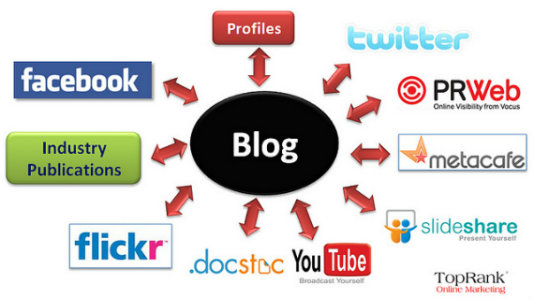
- Promote a blog post through a series of tweets with the most interesting facts from the article
- Turn a blog post into an infographic and post it on Instagram and/or Pinterest
- Make an article a springboard for a podcast
- Turn a blog post into a video that covers the same topic or references while discussing a related topic
See Square2Marketing and TopRankBlog for more hub and spoke examples.
2. Equip Your Readers With Sharing Tools and Design
The easiest way to increase shares is to make sharing easy for the reader. That means fine-tuning your website's visual design to influence reader behavior. If readers simply aren't sharing, try one of these suggestions:
- Place social share buttons prominently and strategically
- Optimize your blog for mobile viewing
- Include ready-to-share summaries, quotes, and excerpts
- Optimize your site for curation tools like Hootsuite and Pinterest
3. Be Selective With Content Topics
There are an infinite number of article ideas in any subject or industry, but many brands just publish content about themselves. This alienates new readers not already engaged. Shareable content is relatable content -- specifically, it's something your audience is eager to learn more about. Brian Razzaque -- CEO and founder of SocialToaster -- put it best in an interview with us last year:
You need to be conscious of the fact that people don't want to always share amazing deals or amazing ads. Once in a while they will, but otherwise they like to sharing things that are funny or meaningful or otherwise interesting. They like sharing videos and pictures and things that are relevant to them as it relates to their lifestyle, or the lifestyle that they want to have.
Where to start? Engage Magazine has a great discussion with expert content marketers about using storytelling to make content more relatable.
See also: Why Anyone Can Be a Compelling Storyteller
4. Don't Sacrifice Quality In Your Content
Producing quality content is the best way to get readers to click share. If you suspect your blog might need some quality improvements, take these steps to improve your odds of success:
- Change Your Headlines: If you publish a post and it doesn't gain traction, consider how the post can be reframed. Next, change the headline and publish again. Track these changes and look for patterns: Do shorter or longer headlines appear to work? Do your readers favor serious-sounding headlines or funny ones?
- Introduction & Subheads: Readers skim. They may only read the subhead and introduction. Consider structuring your articles with subheads and make sure your introduction is enticing.
- Proper Hyperlinking: Hyperlinking to sources and references helps traffic and sharing for a number of reasons. First, it gives supportive evidence to the claims you make in blog posts, giving your content credibility. It also helps search algorithms find your content.
- Be Social: Make your content is having a conversation with the reader. Ask questions, propose options and ask for opinions -- don't hesitate to do this in unexplored issues of popular topics. People don't respond to a monologue, but they will to a conversation.
See also: 4 Ways to Give Your Content a Credibility Boost
Distributing content through social media can be a very powerful and effective strategy to spread your brand's narrative. Success of this kind doesn't happen over night though, and it won't unless your strategy addresses meaning and function. It boils down to two questions: Can they share it? And do they want to?
To Read More About Social Content, See Below:
Ampush: Why Creating Content for Social Media on Mobile is Different [Interview]
Tools You Didn't Know About That Will Measure Your Social Media Content
Social Media: Why It's Best to Rock at One Channel, Not All