Why Scripted Is a Top ClearVoice Alternative
If you’ve been following the industry chatter, you’ve likely heard the news about ClearVoice’s plans to shut down operat...


If you want your business discovered in a crowded, competitive online marketplace, content marketing is essential. Without it, your business won't have a chance. According to a recent HubSpot study, at least 70% of content marketers actively invest in their content marketing efforts, and around 25% of marketers plan to increase their investment in content marketing in the coming years.
Content marketing is a strategic approach focusing on sharing valuable content to attract a defined target audience and drive conversions and profit. Written content can include blog posts, long-form articles, white papers, ebooks, and social media posts, among other types. Videos, webinars, and audio content, such as podcasts, can also play a significant role in content marketing, depending on the company and the target audience.
There's a reason marketers focus on content marketing. When a content strategy is well-developed and search engine optimized (SEO), it becomes a powerhouse traffic driver to a business's website — it grows audiences. In fact, SEO content drives 1,000% more traffic to a site than organic social media.
However, even experienced content marketers can make mistakes.
One of the best ways to ensure your content strategy is doing well is to be aware of five common content marketing mistakes. So, keep reading to learn how and why mistakes happen — and the repercussions — and what you can do instead on your path to content marketing success.

It might seem counterintuitive, but the amount of content you produce and publish is far less important than the quality of the content. It's tempting to fill your blog and social media channels with mediocre stuff as often as possible.
Your content doesn't need to win awards, though it should be of very high quality. It must solve the problems or pain points your target audience is experiencing. If the content doesn't provide what they need, they won't read or share it. Be sure your content is informative, engaging, and relevant.
Content that misses the mark can include a variety of problems, and not all are obvious. Here are some common signs of low-quality content:
High-quality content delivered less often generates anticipation and prevents content from getting lost in the online information onslaught. Consistently crafting high-quality content is part of a solid marketing strategy. Here's how:
PRO TIP: Catchy headlines for blog posts are a must if you want to stand out from the competition. You could spend hours brainstorming and still feel like it's not quite right. Why not try our free Headline Generator? Just type in a topic like "how to raise a puppy" or "how much to save for retirement" and click "Get Headlines." Within seconds, you'll get ten great possibilities. Edit or tweak a couple you like, or use them as they are. Want more ideas? Try it again.
Remember, you're better off with infrequent, high-value content than rolling out a daily deluge of hit-or-miss pieces. Quality content builds respect and trust and helps you achieve your marketing goals.

Imagine planning your first trip around Europe. You have only three weeks to visit old castles and Roman ruins in ten countries. It's 1990, and GPS has yet to be widely available. Would you plan and choose your route carefully? Pack a map? Or would you wing it?
Without a plan and a map, you won't get far, and too many things can go wrong. The same applies to content marketing.
A content strategy is like a blueprint or map that defines your approach to content marketing. It outlines your goals, target audience, and the type of content you'll focus on. A strategy also includes content distribution channels, such as social media and email.
A content plan is part of your content strategy. Also known as an editorial or content calendar, it helps you stay on task and evaluate progress. It also aids in managing the content production and publishing process: the what, when, and where of content marketing.
Without a clear travel plan, you'll get delayed and discouraged. You won't get to the castle in Germany if you're out of gas in rural Italy. The same thing happens without a marketing strategy.
You need detailed plans for the types of content you'll produce and who creates it. What are the standards, and how will they be achieved or communicated? What's a reasonable time frame? Your content marketing will be disorganized and inconsistent without a strategy. Plus, it might not be aligned with your goals or your target audience's needs. Even if you create high-quality content, each piece alone won't grow your business. You need a strategy and a plan.
Here's what can happen if you don't have a good content marketing strategy:
Do any of these examples sound familiar, or do you just want to avoid mistakes? Here are some content strategy examples that can work in your favor:
PRO TIP: One way to develop a content plan is to use Scripted's GPT-4 powered content strategy expert, Scripted Copilot. Using pre-written questions, you'll have a content plan and a content calendar you use right away! 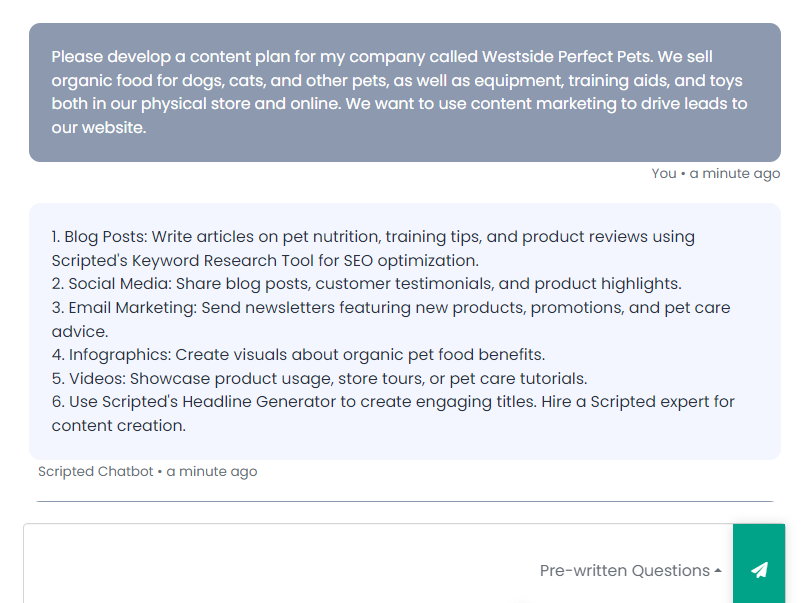
Here's what to do: Select the pre-written question. Develop a content plan for [company/website/industry]. Add your information to replace "company/website/industry" and other details. Click on "Pre-written questions" for content calendar options,
Start your free trial to see what Scripted Copilot can do!
No matter what your business goals are, a well-crafted content strategy and plan saves time and money in the long run. Creating high-quality content regularly and promoting it on the right channels means new leads and customers to grow your business.
SEO (search engine optimization) is essential to creating content that builds your business. If your content isn't optimized, your target audience won't find it when searching for needed information. It will simply exist and take up space instead of working to build your brand.
But here's the mistake many people make: learning SEO and using the same thing they learned over and over again. SEO constantly evolves, and Google frequently updates algorithms. That means the "right" way to optimize your content can change quickly. Staying abreast of SEO updates ensures you know the current best practices for your content. You're not relying on techniques that worked a month, a year, or five years ago.
By avoiding outdated SEO practices, you can be confident your audience will find your content, and you won't lose potential business. Don't risk your content getting overlooked because you created it using old, irrelevant guidelines.
Here are just a few of the most common SEO practices that won't do you any favors:
If a company or content marketer follows these outdated SEO practices, they could face the following repercussions:
Adopting ethical, white-hat SEO practices and staying current with changes isn't complicated. In fact, it's easier.
PRO TIP: Although SEO best practices are constantly changing, and keyword stuffing has always been a bad idea, you still need to use the right keywords so potential readers can find your content.
Scripted's AI Keyword Research Tool helps you optimize your content strategy with keyword idea generation. The Keyword Research Tool identifies relevant, effective keywords for content marketing. By analyzing search trends and other data, the tool suggests keywords likely to generate the most traffic and conversions. Using keywords naturally in your content helps optimize content for search engines and improve search engine visibility.

In the good old days, many marketers and bloggers believed, "If you build it, they will come." Just create a website, write some snappy blog posts, and BAM. You're in business.
Today, everyone (hopefully) knows that doesn't work. Still, even with the best SEO, you have to get your content in front of people through social media, email marketing, and paid advertising.
Write a quick post or email, add a link, and BAM. Done.
If you're a magician, that might work. But for the rest of us, if you don't know who your target audience is, you might be better off renting a plane and dropping printed ads all over New York City on a windy day.
Your content can't reach potential customers without targeting a specific audience. You need to get familiar with their needs and interests. What problems — what pain points — are they trying to solve? What kind of content do they consume? What are their favorite social media platforms?
Not identifying a target audience is a common mistake. But if you want your content to earn more leads and improve sales, you need to be specific.
Failing to identify a target audience can lead to the following problems:
Defining your target audience is an essential part of your content marketing strategy. Businesses can create more compelling content that reaches the right people and achieves their marketing goals.
Define your target audience with these tips:
When you have a good understanding of your target audience, you can start to develop a content marketing strategy tailored to their specific needs.
Suggested Reading: Reaching the Senior Audience

Once you've created great content, you need to promote it so people can find it. By sharing your content on social media and emailing it to your subscribers, you create opportunities for engagement with your target audience, which can lead to social sharing, backlinks, and word-of-mouth advertising.
But if you don't promote your content and rely only on website SEO, you're missing chances to improve your website's visibility and increase traffic, leads, and sales.
Lack of content promotion can lead to problems, including:
Here are some ways to promote your content:
The best ways to promote your content varies depending on your target audience and industry. But by using a variety of promotion channels, you can expand your reach so more people can engage with your content.
PRO TIP: Scripted is big on both AI tools and human writers. One area where AI shines is when you need quick, templated content. That includes social media posts. Promoting your content on social media increases brand visibility and engagement across multiple platforms. You don't need to say much for content promotion, but you want it done right.
Why not try our AI-powered Social Media Post Generator? Along with your content marketing strategy and plan, you can create social media posts in batches. With Scripted's Starter Plan, it's completely free. Just sign up for an account and let our Social Media Post Generator get to work! You can use all our free AI tools to save time, money, and resources on your templated content.
Don't waste time and money on AI prompt engineering or hiring for an expensive new role. Take advantage of our easy-to-use, customizable AI tools combined with the power of experienced writers. You can stay ahead of the competition if you get started right now.
Whether you're a business owner or marketer, a top-notch content marketing strategy holds the key to lead generation, conversion, and sales. Content marketing doesn't produce results as fast as well-designed paid ads can. It takes a little longer. But the advantage of useful content like blog posts is they have staying power. PPC (pay-per-click) ads and other forms of paid advertising stop producing leads when you stop paying for them. But high-quality content lasts forever.
Need help with your content strategy? Scripted is the only platform that empowers users to switch effortlessly between AI-generated content and content crafted by human experts. Scripted eliminates the need for multiple platforms by providing a single, comprehensive solution that caters to both AI-generated and human-written content. Experience a new level of content marketing with Scripted — where AI meets human expertise, efficiency meets impact, and your content goals become reality.
Get started with a free 30-day trial or schedule a short video call with a Scripted Content Strategist.