

Why The Smartest Marketers Have External Writing Teams
At the core of every content strategy is creation - and for written content, that's writing. A successful content strate...



A content tune-up takes an existing blog post or web page that isn't performing up to expectations and gives it a update to improve readability and increase visibility on the search engines.
We performed a content tune-up recently for Scripted customer GetCuros.com and they agreed to let us show you what you can accomplish with some simple tweaks to existing content.
On June 21, GetCuros created a very informative, well-researched, and well-written blog post titled, "Erythritol: A Perspective on The Benefits and The Dangers of This Common Sugar Substitute" but it wasn't finding the audience it deserved.
We kept the original copy here.
The original author did all the necessary research and presented all the pros and cons of Erythritol in a clear and concise manner. So why no search engine love? Why wasn't it being shared or naturally gaining links?
The problem rested largely in its on-page SEO (keywords!) and structure.
Something that could be easily fixed with a content tune-up.
The first major problem was that the article did not have a clear keyword focus. The keyword "erythritol" was used enough throughout (65 times!), but the major information about erythritol within the article was buried in long paragraphs under ambiguous subheadings.
The title, though a little long, worked because it clearly explained what the article was about and included our focus keyword "erythritol." We left it as is.
The first paragraph needed some work. It's important to clearly state the thesis of the article up front, include your focus keyword, and get to the meat of the article as quickly as possible. In the original the author started with a hypothetical and did not include the focus keyword.
Original intro:
"Have you ever taken a swig of the new Absolutely Zero variety of Monster Energy(r) drink? Or perhaps you've tried Grandma Koyote's(tm) BBQ Sauce, or Quest Bar(tm) protein bars? Maybe you like to dump a packet of Truvia(r) into your coffee every morning?
If you've sampled these or many other sugar-free products on the market, you've consumed a sugar-like substance called erythritol."
Tune-up intro:
"It's likely that you've consumed this sugar substitute without even knowing it. Erythritol is probably already in the food you eat so it pays to understand what exactly it is, how it's made, and the potential health consequences. This article will give you all the background you need to better understand your diet and make more informed choices. We'll also discuss several other sugar alternatives to consider as well."
As you can see we don't waste any time in the new introduction. We introduce why the piece is written and explain what you will get out of reading it. Quick and easy. Now onto the meat of the article.
What questions did this article answer? Quite a few. Here are the big ones:
Though these questions were answered in the original text, the subheadings were too conversational and the article was not structured for quick and easy consumption.
We took these questions and turned them into keyword-focused subheadings throughout the article. Turning your most important information into H2 subheadings helps readers and search engines know what information can be found and where to find it.
Original Subheadings:
New Subheadings:
The new subheadings are keyword-focused and make scanning for specific answers easy. This makes readers happy, and happy readers lead to more shares and higher rankings.
Buzzsumo did a study that found that blogs with images every 75-100 words got double the amount of shares of articles with fewer and a minimum of 30 more shares than articles with more. Choosing the right images and including keyword-rich meta-data can also be a simple way to give a blog post an SEO boost. So we 5 images to the body of the article and optimized the title tag and meta description.
Title tag: Erythritol: A Perspective on The Benefits and The Dangers of This Common Sugar Substitute | GetCuros
Meta-description: Erythritol is alcohol commonly found in sugar and found naturally in some fruits and other foods. Here we discuss the health benefits, dangers, and alternatives to erythritol.
There you have it, 3 simple steps to improve the article's SEO and readability. That's all. Let's take a look at the impact of these changes.
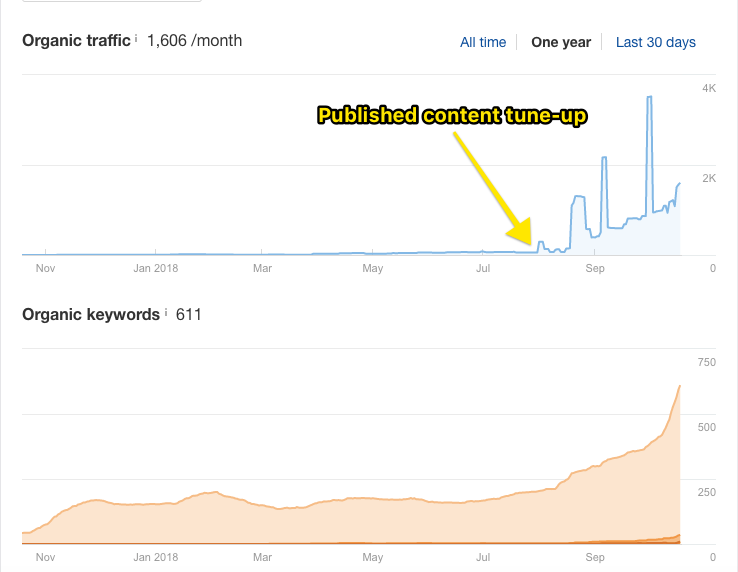
After a year of virtually no traffic or visibility, our simple content tune-up gave this blog post new life.
The update went live August 8, and by early September we started to see real change in traffic and organic rankings. The blog now ranks for over 800 keywords and bringing in over 1,600 visitors a month.
Here is a list of search terms the updated post now ranks on page 1 for:
| Search Terms | Volume | Keyword Difficulty | Traffic | SERP Position |
| erythritol | 192,000 | 22 | 3,048 | 9 |
| erythritol danger | 4,000 | 20 | 262 | 3 |
| erythritol dangers | 1,600 | 26 | 51 | 4 |
| erythritol benefits | 70 | 17 | 27 | 1 |
| does erythritol raise insulin | 50 | 35 | 19 | 1 |
| does erythritol cause diarrhea | 150 | 23 | 15 | 4 |
| does erythritol spike insulin | 100 | 35 | 13 | 3 |
| erythritol health dangers | 30 | 17 | 11 | 1 |
| erythritol stevia dangers | 100 | 24 | 9 | 5 |
| erythritol benefits | 70 | 17 | 9 | 3 |
| erythritol insulin | 150 | 35 | 8 | 6 |
| erythritol risks | 20 | 19 | 7 | 1 |
| erythrol | 150 | 22 | 6 | 8 |
| does erythritol cause cancer | 90 | 14 | 5 | 6 |
| can erythritol cause diarrhea | 60 | 24 | 5 | 4 |
| does erythritol raise insulin | 50 | 35 | 4.8 | 4 |
| does erythritol cause gas | 150 | 24 | 4.8 | 4 |
| dangers of erythritol | 40 | 26 | 4.0 | 9 |
| erythritol health dangers | 30 | 17 | 3.5 | 3 |
Writing for the web has a very specific set of rules. Making some simple changes to your existing content to abide by these rules can be the difference between content success and seeing all your hard work go to waste.